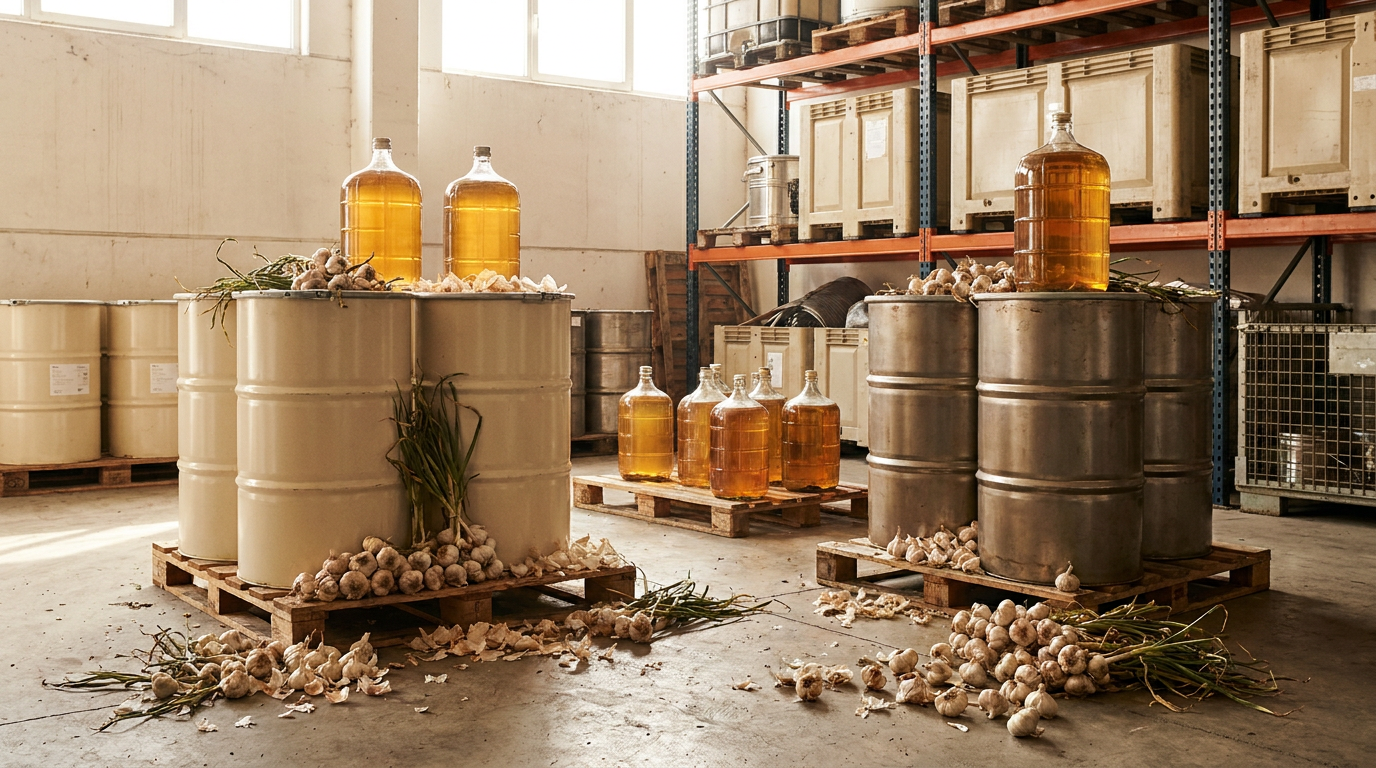
Garlic essential oil is a niche but genuine wholesale commodity, distilled for potency rather than diluted for a faint suggestion of the plant. This guide covers what separates true steam-distilled oil from imitators, how to read a supplier's documentation, and which bulk size fits a given production run.
See current pricing across every pound tier on the wholesale page.
Garlic essential oil is steam distilled from crushed bulbs of Allium sativum, a process explained in full in how garlic essential oil is made. Distillation drives off water and concentrates the plant's sulfur aromatics into a single layer, which is why the chemistry behind the smell, covered in why garlic oil smells the way it does, is so much stronger than a fresh clove on a cutting board.
For buyers new to the category, what is garlic essential oil lays out the baseline: bulb, method, and aroma profile in one place. Steam distillation is not the only route to a garlic aromatic; some suppliers work from CO2 extraction instead, and the practical differences between the two methods, covered in steam distilled vs CO2 extracted garlic essential oil, matter for anyone specifying a method on a purchase order.
Buyers sourcing at scale also need to separate the true essential oil from infused and flavored substitutes before requesting a quote, a distinction laid out in garlic essential oil vs garlic infused oil.
| Sold as | What it actually is | How to recognize it |
|---|---|---|
| Garlic essential oil, steam distilled | The genuine article: Allium sativum bulbs steam distilled to a concentrated aromatic oil, sold undiluted. | Labeled with the botanical name and extraction method, backed by a lot-specific Certificate of Analysis. |
| Garlic infused oil | A carrier oil, usually olive or sunflower, steeped with garlic pieces or garlic extract. Far weaker in aroma. | Ingredient panel lists a carrier oil first and garlic as a flavoring, with no distillation method named. |
| Garlic oleoresin or CO2 extract | A different extraction path that pulls a broader, often thicker aromatic fraction than steam distillation. | Marketed as an extract rather than an essential oil, frequently darker and heavier bodied. |
| Synthetic garlic flavoring | A lab-built blend of isolated sulfur compounds meant to mimic the smell without any bulb behind it. | No botanical name or extraction method on the label at all, just a flavoring designation. |
The confusion runs in more than one direction: shoppers also mix this oil up with garlic-and-olive-oil condiments sold in the same aisle, a mix-up covered from the retail side in garlic essential oil vs garlic olive oil at the store, and with the neighboring allium oil most often confused with it in garlic oil vs onion oil.
The sourcing trap here is simple: a bottle labeled 'garlic oil' on a wholesale marketplace is, more often than not, a diluted infusion rather than a steam-distilled essential oil, and the two are not interchangeable in a formulation built around drop-level dosing.
Wholesale demand for this oil is narrow but real, concentrated among buyers who need the concentrated aroma rather than a mild suggestion of garlic. Wholesale garlic oil: bulk buying for kitchens and formulators covers the kitchen side of that demand, from commissary sauce lines to condiment makers scaling a recipe past the home batch stage.
Before committing to a drum-scale order, most serious buyers work through the same due diligence: reading a source's documentation the way buying garlic oil: the complete quality and sourcing guide recommends, and sometimes running a real-world trial first, along the lines of the single-bottle usage tracked in case study: a week of cooking with one bottle of garlic essential oil, before scaling that rate up to a pound-tier order.
Before placing a bulk order, confirm the following on paper, not just on the label.
Documentation is the whole game at wholesale volume: a supplier without a lot-specific Certificate of Analysis is asking a formulator to guess at potency, and guessing does not scale past a single bottle.
Bulk sizing for this oil runs from a 0.5 oz sample bottle up through 400 lbs, and the right starting point depends on where a buyer sits in their own testing cycle. First-time buyers are usually better served starting small, a decision walked through in your first bottle of garlic essential oil: which size to order, before committing to a pound-tier drum.
Once a formulation or recipe is locked, the jump to 5 lbs, 25 lbs, 100 lbs, or 400 lbs is a pricing and logistics decision more than a testing one; see /bulk/ for current wholesale pricing at each tier.
Start with a 0.5 oz or 1 oz bottle to confirm aroma strength against your own recipe or formulation, and check the batch documentation against the published Certificate of Analysis at /docs/garlicessentialoil-coa.pdf.
Run a small production batch at 2 oz to 8 oz to confirm dosing rates hold up outside a test kitchen, tracking usage the way the single-bottle case study does.
Request pricing at the pound tier that matches your production volume through /bulk/ or /contact/, and confirm lead time and lot availability before committing.
Standing orders at 25 lbs, 100 lbs, or 400 lbs should reference the same lot documentation standard each time, not just the first order.
The sections below cover the specific buyer categories that make up wholesale demand for this oil.
Commissaries, sauce lines, and condiment makers who need consistent garlic strength without steeping fresh bulbs in every batch.
Read the sourcing guide →Grilling season and bread service producers who build a signature garlic note into a bottled marinade, baste, or finishing drizzle.
Read the sourcing guide →Chili crisp, mayu, and infused-oil condiment producers who need a concentrated garlic base rather than a slow bulb infusion.
Read the sourcing guide →Manufacturers of natural, garlic-based garden sprays who need concentrated oil to dilute into a field-ready formula.
Read the sourcing guide →Craft studios working garlic into a savory or novelty candle and soap line who need concentrated, verifiable oil.
Read the sourcing guide →Specialty bait makers who scent lures and prepared bait with concentrated garlic oil for a strong, lasting draw.
Read the sourcing guide →Bottlers and formulators building a private-label garlic oil product who need a verifiable, well-documented source.
Read the sourcing guide →Reach out directly and we will walk through documentation, sizing, and lead time.